
Belém, Brazil, November 12, 2025 — Fire has long played a natural role in shaping many of the world’s landscapes. But supercharged wildfires – more frequent fires that burn longer and hotter and flare up in places not supposed to burn – now rank among the greatest threats to forests worldwide. A report from the Monitoring of the Andean Amazon Project (MAAP) found that wildfires affected 2.8 million hectares across the Amazon, setting a new regional record and surpassing the previous high of 1.7 million hectares in 2016. In other regions, the situation follows the same trend: in 20 years, wildfire extent is up by approximately 40% – largely outside the tropics – and the intensity of the most extreme events has doubled (State of Wildfires 2024–2025).

These fires threaten the stability of ecosystems and communities and increase carbon emissions from sources long considered stable carbon vaults. The picture is clear: wildfires have become a defining challenge of our time, and the world needs new models for addressing them.
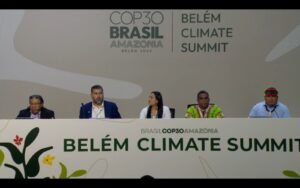
As the world gathers in Belém for COP30, leaders have a chance to turn the tide from reaction to prevention. Today, under the leadership of tropical countries including Ecuador, Peru, Ghana, and Kenya, as well as the State of Acre in Brazil – and with strong mobilization by civil society, Indigenous Peoples, and local organizations – the Wildfire Action Accelerator Pledge is being launched. This global pledge marks a milestone in building wildfire resilience across tropical regions and embedding prevention-first approaches into climate and biodiversity action.
Environmental Defense Fund (EDF), together with civil society partners from 18 countries and regions, including Ecuador, Peru, Costa Rica, Brazil, Mexico, Ghana, Kenya, India, Guatemala, Colombia, Panama, Bolivia, the United States, the Netherlands and the United Kingdom – and regional networks AMPB (Mesoamerica) and REPALEAC (Central Africa), is helping convene this diverse coalition. Global partners such as BirdLife International, Hivos, the Global Wildfire Collective, and the FSC Indigenous Foundation are joining forces to ensure the Pledge delivers impact from the local to the global level.
A Collective Commitment for a Prevention-First Future
The Wildfire Action Accelerator Pledge unites forest nations, Indigenous Peoples and Local Communities (IPLCs), donors, and multilateral partners around one message:
Wildfire resilience is central to protecting forests, people, and the planet; therefore, it is imperative that it be integrated into global climate and biodiversity frameworks, including the Paris Agreement and the Kunming-Montreal Global Biodiversity Framework.
The Wildfire Action Accelerator Pledge will help mobilize coordinated investment and technical cooperation, connecting prevention, financing, and traditional fire governance to build a safer and more sustainable future for tropical forests.
The declaration builds upon existing global frameworks, including the Glasgow Leaders’ Declaration on Forests and Land Use, the Kunming-Montreal Global Biodiversity Framework, the Kananaskis Wildfire Charter adopted by the G7, and Brazil’s Call to Action on Integrated Fire Management and Wildfire Resilience.
The Wildfire Action Accelerator will prioritize tropical forest countries, with an initial focus on the Amazon Basin, the world’s largest tropical forest region and one of the most fire-threatened. However, in the spirit of South-to-South collaboration, the Wildfire Action Accelerator remains open to supporting and sharing lessons with other tropical regions facing similar wildfire risks.
A Concise Summary of the Four Pillars of the Pledge
- Center Traditional Knowledge and IPLC Leadership
Indigenous Peoples, Local Communities, and Afro-descendant Peoples are stewards of fire-resilient landscapes. Their ancestral knowledge, gender roles, and territorial rights are vital to effective fire governance. We commit to integrating traditional fire knowledge into national policies and legal frameworks, securing recognition of customary practices, and co-designing inclusive governance mechanisms that uphold IPLC rights and voices. - Mobilize Sustainable and Equitable Fire Finance
Global fire finance must shift from reaction to prevention. We will promote national and regional funding instruments for integrated fire management, advocate for dedicated wildfire windows in mechanisms such as the GEF, GCF, and development banks, and align all financing with national public finance systems. We support public–private models that channel long-term investment into resilience and sustainable forest economies, including REDD+ and the Tropical Forest Forever Facility. - Embed Wildfire Management into Climate and Forest Policy
Wildfire risk must be addressed as a systemic climate and development challenge. We will integrate wildfire governance into NDCs, REDD+ strategies, and forest policies; strengthen cross-ministerial coordination; and transparently report wildfire-related emissions under the Paris Agreement. - Advance Global and Regional Collaboration
We commit to deepening collaboration through platforms such as the FCLP, Global Fire Management Hub, ACTO, and AU Great Green Wall, integrating new technologies and forging synergies with initiatives such as FireSat and the Earth Fire Alliance, while advancing Tropical Dialogues to Speed and Scale Wildfire Response – evolving by 2026 into a Global Dialogue on Wildfire Governance with strong South–South and North–South cooperation.
Milestones for 2030
- 20 forest nations formally recognize traditional fire knowledge.
- $100 million mobilized for community-based fire resilience.
- 5 jurisdictions dedicate carbon revenues to fire prevention.
- 15 countries embed wildfire risk in NDCs or REDD+ strategies.
- A Tropical Dialogue and regional peer platforms fully operational by 2026.
COP30 Wildfire Action Accelerator Pledge: Speeding and Scaling a Paradigm Shift to Address Wildfire in Tropical Forest Countries. Full text: